About ForaCare

This author has not yet filled in any details.
So far ForaCare has created 58 blog entries.

MUSC Study Finds Kidney Recipients Improve with FORA Devices and Pharmacist Visits

In a study conducted by the Medical University of South Carolina, African-American kidney transplant recipients saw an improvement in medication safety, glycemic control, and blood pressure control after using FORA® devices and a mobile health app along with monthly interactions with a pharmacist.

The study assessed racial disparity as well as the efficacy of improved medication safety and cardiovascular risk control. Download the report to read more about the study and its results.

FORA TN’G SpO2 Device Removes Stress of Uncomfortable, Expensive Sleep Tests

ForaCare has recently released the new FORA® SpO2 device—a simpler, more cost-effective solution to monitor pulse oxygen overnight in the comfort of a person’s home—which can help physicians diagnose health complications such as sleep apnea.

Patients can place the FORA SpO2 device on a finger to perform a sleep test in their home, continuously measuring pulse oxygen and beats per minute. Since the device is small, lightweight and easy to use, it’s easier to track sleep trends over multiple evenings to see if results improve or worsen.

The device connects to the iFORA O2 smartphone app via Bluetooth and is able to provide various reports based on the data captured including a sleep report and Heart Rate Variability (HRV) analysis.  

The HRV analysis will test a person’s autonomous nervous system, which brings insight into their physical and mental state in just three or five minutes. A higher HRV is associated with a healthy person in a more relaxed mental state while a lower HRV indicates excessive stress or fatigue, sleep disorders, physical illness, and disease risk.

HRV results could even help physicians diagnose potential health problems including hyperthyroidism, hypertension, diabetes, anxiety, and depression.

Additionally, the breath frequency feature in the iFORA O2 app allows users to practice breathing techniques: 10 minutes of morning exercises can improve physical and mental state throughout the day and 10 minutes in the evening can improve quality of sleep.

Breathing exercises can also help improve snoring, anxiety and stress, asthma, nasal congestion, high blood pressure and more.

For more information on the FORA SpO2 device, click here. Download the app in the App Store or Google Play.

FORA Mobile Care Station Provides Best Cost Advantage for Long-Term Care Facilities


The FORA® Mobile Care Station’s features include:

  • The Latest Innovative Technology

The Mobile Care Station includes up to 5 devices that measure blood glucose, blood pressure, pulse oxygen, temperature, and weight. The long-term care facility has the option to choose only the vital signs they need to help control costs.

  • Data Integrity

Prior to taking a patient’s measurements, the staff is able to confirm the patient’s identity through their patient profile picture on the iFORA CS (PCC) app. Plus, the nurse can verify the data before uploading results to the electronic health record.

  • A Reduction in Errors

Since measurements automatically populate from the meter to the iFORA CS (PCC) app, staff no longer needs to spend time transferring that information and none of that data will accidentally be written down incorrectly. This leads to a cut in costs as well.

  • HIPAA Compliant

The Mobile Care Station meets or exceeds all HIPAA requirements because of its complex encryption and authentication measures, which can potentially reduce overall HIPAA violation exposure.

Watch the video for a more in-depth look at the Mobile Care Station’s features and functionality.

ForaCare Presents Remote Patient Monitoring Solution to Local Cardiovascular Physicians

ForaCare demonstrated its remote patient monitoring solution to the Cardiovascular Institute and the Chest Center of Los Robles Hospital and Medical Center. Remote patient monitoring, which includes ForaCare’s telehealth devices and connected software, is a simple, easy-to-use solution to manage chronic care patients better in an effort to improve patient outcomes.

“I think it’s beneficial in certain settings for us. With the programs that we’re adding, I think it can be helpful,” said Tammy Martin, practice manager.

For more information on our remote patient monitoring solution, please contact ForaCare. 

MUSC study finds remote patient monitoring significantly lowers HbA1c

The Medical University of South Carolina (MUSC) conducted a study using ForaCare’s remote patient monitoring solution to determine the effect of telehealth on the blood glucose levels of low-income rural adults with poorly controlled type 2 diabetes.

The Medical University of South Carolina

MUSC, one of the two National Telehealth Centers of Excellence, found that after six months, patients who used the FORA® D40 2-in-1 blood glucose and blood pressure meter to manage their health had a 0.99% reduction in HbA1c levels and the rate of decline in HbA1c was faster than the control group.

“ForaCare is honored to support MUSC’s Technology Assisted Case Management study, providing the tools combined with their intensive intervention protocols resulting in improved patient outcomes. This qualifies how effective remote patient monitoring helps those rural patients who would otherwise not see their physician on a consistent basis and our D40g cellular device and 24/7 Telehealth patient management cloud are able to effortlessly provide valuable data,” said Myron Talbert of ForaCare. “In connecting the FORA devices to our telehealth system, we can achieve better health outcomes and reduce costs.”

Participants in the study included 113 diabetic patients who were randomized into either the Technology-Assisted Case Management (TACM) intervention group or the control group.

The TACM patients were given a FORA D40 device to take their blood glucose and blood pressure measurements at home. The results were then automatically uploaded via cellular connection to the 24/7 HealthView Telehealth System, which was accessible to the patient’s physicians for regular review.

Additionally, a nurse case manager adjusted each participant’s medications every two weeks based on the data trends to help control glucose levels.

Studies suggest that even a 1% reduction in HbA1c results in cost-savings and major health improvements including:

  • 21% reduction in diabetes-related deaths
  • 37% reduction in neuropathy and retinopathy
  • 14% reduction in heart attacks
  • 45% reduction in cardiovascular death

Review the abstract here.

ForaCare to Attend 2019 Telehealth Summit, May 21–23

ForaCare will present its complete telehealth solution at next week’s California Telehealth Resource Center’s 2019 Telehealth Summit as well as two evidence-based case studies that support improved health outcomes because of ForaCare’s complete solution.

ForaCare’s complete solution is comprised of a range of FORA® devices that connect to the FORA 24/7 HealthView Telehealth System. The glucometers, blood pressure meters, pulse oximeters, thermometers and weight scales provide quick and accurate results on a large LCD display making it easy to read. Many FORA devices speak the results, too.

With multiple options to connect from the device to the telehealth software, providers can choose the ForaCare solution that works best for them and their patients. Cellular devices connect to the 24/7 HealthView telehealth software directly, while Bluetooth meters connect to a mobile app before uploading data to the telehealth software. The Gateway serves to upload data from the device to the telehealth software, which is especially useful if a patient uses multiple devices.

COPD patients in Florida who were part of the Telehealth After COPD Hospitalization Study, for example, used the Gateway to upload blood glucose, blood pressure and weight information from their devices to the telehealth software automatically. The study, which will be featured at the summit, measured the effect of telehealth and home visits on COPD patients after hospitalization, resulting in a 5% readmission rate instead of the 13­–20% national average.

The second study that will be highlighted at the summit was conducted by the Medical University of South Carolina. They monitored diabetes patients over six months and found that those who used the FORA 2-in-1 blood glucose and blood pressure device showed a 0.99% decrease in HbA1c compared to the control group.

For more information on the case studies, and a live demonstration of ForaCare’s complete solution, stop by booth #9. Plus, pick up some freebies and enter the raffle for your chance to win a FORA TN’G SpO2!

California Telehealth Resource Center & California Telehealth Network 7th Annual Telehealth Summit

Hyatt Regency Mission Bay, Regatta Pavilion

1441 Quivira Road

San Diego, CA 92109

Prestige Healthcare Supplies Expands Business with FORA Mobile Care Stations

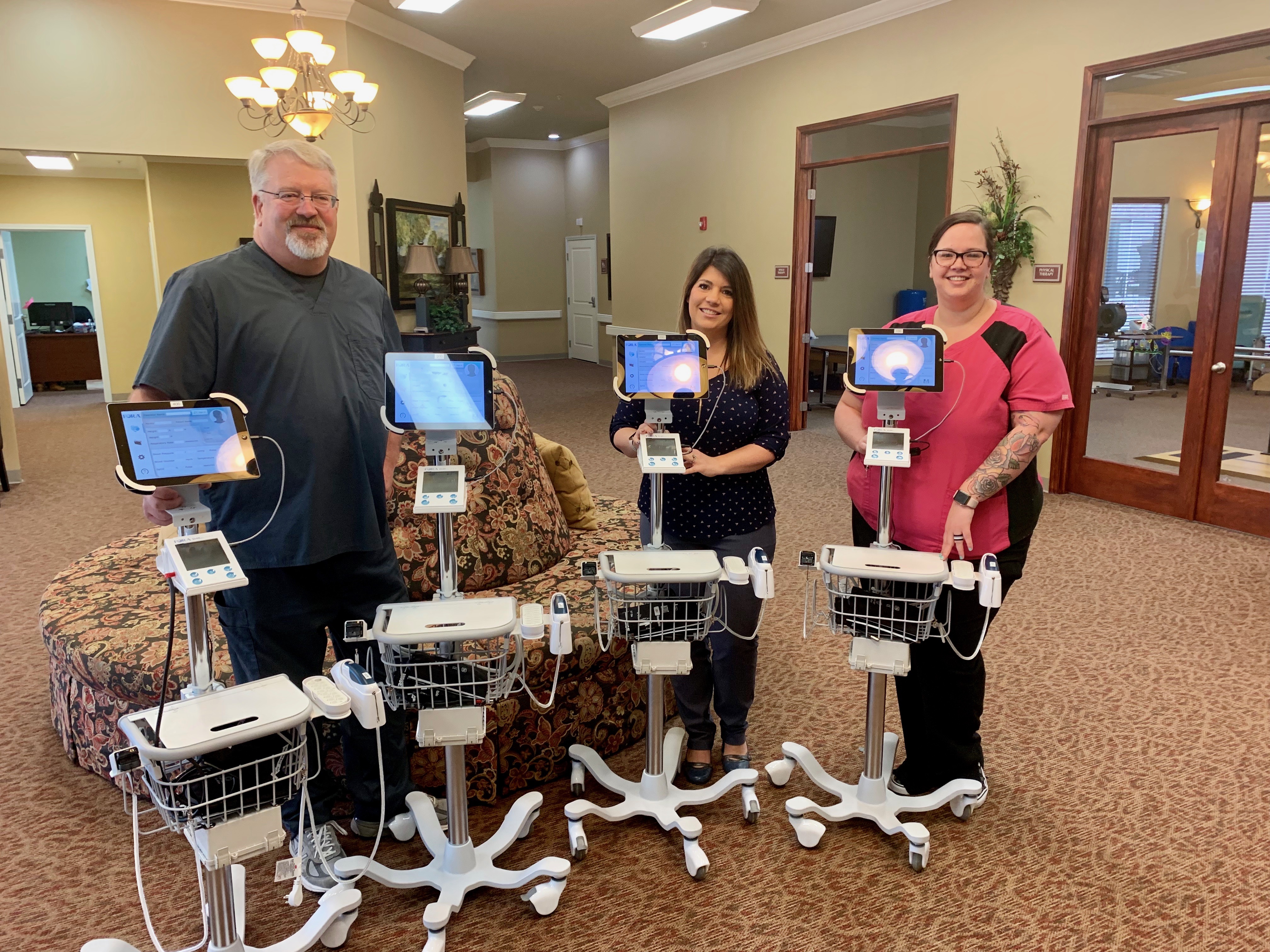
Prestige Healthcare Supplies recently partnered with ForaCare Inc. to distribute FORA Mobile Care Stations to nursing facilities to improve the process of capturing and monitoring vital signs.

“Many facilities still rely on manual entries for vital sign measurements,” said Scott Gentry, owner of Prestige Healthcare Supplies. The Mobile Care Station makes the staff’s job much easier since it automatically uploads data directly from its monitoring devices to the PointClickCare Electronic Health Records; no manual entries required.

Prestige Healthcare Supplies owner Scott Gentry, along with a nursing home administrator and director, presents the FORA Mobile Care Stations.

“Usually they’re all so excited when we first get in there. It’s better than what they had,” he said. “They’re really excited to have their own Mobile Care Station in each hallway.”

The nursing facilities have already seen positive outcomes as a result of the Mobile Care Station. For example, the ForaCare system has alerted nursing facility staff to various health complications such as atrial fibrillation and they were able to take action immediately. The Mobile Care Station also saves staff time and makes everyone more accountable because of the time/date stamp that comes with every measurement.

“When the Mobile Care Station was formed, I could see the promise in it,” Gentry said.

Gentry initially began working with ForaCare under his company Prestige Medical Supply Inc. selling diabetes meters and test strips. Once the Mobile Care Station was released, Gentry decided to create an offshoot company with its focus solely on the Mobile Care Station.

“I’m very positive about it,” he said about the partnership. “Our philosophy here is: we’re just a team. We’re doing all we can on our side and they’re doing all they can on their side. I’ve never once felt abandoned by ForaCare. Any time we’ve had an issue it’s been dealt with as soon as possible.”

Linda Guillot, ForaCare’s Senior Sales Executive shared his sentiment stating, “It has been really exciting working alongside Scott and Prestige Healthcare Supplies to grow the Mobile Care Station sector. We couldn’t be happier with the success of our partnership!”

For more information on the Mobile Care Station or to request a live demo, please contact us.

Premium V10 BLE Helps Manage Diabetes

The FORA® Premium V10 BLE blood glucose monitoring system is designed for diabetics who want to see their glucose trends over time, at any time.

Because regular testing and reviewing of glucose measurements help patients manage their diabetes, the Bluetooth connectivity to the iFORA Diabetes Manager app for iOS or Android is an especially significant feature of the Premium V10 BLE. 

The mobile app brings clear attention to a patient’s abnormal trends through color coding: red indicating a high measurement and yellow signifying a low result. Reviewing these regularly can help diabetics understand what they need to do to balance their glucose levels—whether it means adding a snack to the day so their levels don’t drop or speaking to their physician about changing their medication dosage.

With the app, patients can record and track results, set individual goals and create plans for 7, 14, and 30 days. The app also distinguishes results between pre-meal, post-meal, morning and evening on the various graphs.

Patients can click on individual results to view each number in larger print. Plus, they can email singular measurements, a full calendar of data or glucose data graphs to family, caregivers or physicians.

Results can also be uploaded to the FORA 24/7 HealthView Telehealth System, which allows care providers the ability to monitor their patients’ measurements in real-time.

Features of the Premium V10 BLE glucometer:

  • Talking voice guided: speaks instructions and final results
  • Audible results in English, Spanish and Chinese
  • Set up 4 alarm settings to alert diabetics when a measurement is needed
  • Stores up to 450 results
  • Easy slide strip ejector

Medicare Remote Patient Monitoring Reimbursement FAQs

Remote Patient Monitoring (RPM) is the next big thing in medical care; patients just don’t know it yet.  And, it seems, neither do many physicians.  On Thursday, CMS published the final rule on its new RPM codes, officially titled “Chronic Care Remote Physiologic Monitoring.”  There are three new RPM codes, all of which will go live starting January 1, 2019.  These codes incentivize providers to effectively and efficiently use RPM technology to monitor and manage patient care needs.  

1. Does Medicare Already Cover Remote Patient Monitoring? 

Yes.  Even before the new codes, Medicare already offered separate reimbursement for RPM services billed under code 99091.  That service is defined as the “collection and interpretation of physiologic data (e.g., ECG, blood pressure, glucose monitoring) digitally stored and/or transmitted by the patient and/or caregiver to the physician or other qualified health care professional, qualified by education, training, licensure/regulation (when applicable) requiring a minimum of 30 minutes of time.”  It went live for the first time on January 1, 2018.   

2. Why Did CMS Create the New RPM Codes? 

While industry advocates generally applauded CMS for activating code 99091, they recognized how that code fails to optimally describe how RPM services are furnished using current technology and staffing models.  This failure may be due to the fact that code 99091 is 16 years old and had never before been a separately payable service.  (It is an older code CMS “unbundled” and designated as a separately-payable service.)  Indeed, the AMA’s CPT Editorial Panel developed and finalized the three new RPM codes in late 2017.  These are the codes CMS finalized effective in 2019.  The new codes do a far better job in accurately reflecting contemporary RPM services. 

3. What Are the New RPM Codes? 

The new Chronic Care Remote Physiologic Monitoring codes are: 

  • Code 99453: “Remote monitoring of physiologic parameter(s) (eg, weight, blood pressure, pulse oximetry, respiratory flow rate), initial; set-up and patient education on use of equipment.” 
  • Code 99454: “Remote monitoring of physiologic parameter(s) (eg, weight, blood pressure, pulse oximetry, respiratory flow rate), initial; device(s) supply with daily recording(s) or programmed alert(s) transmission, each 30 days.” 
  • Code 99457: “Remote physiologic monitoring treatment management services, 20 minutes or more of clinical staff/physician/other qualified healthcare professional time in a calendar month requiring interactive communication with the patient/caregiver during the month.” 

4. How Much Time is Required to Bill Code 99457? 

At least 20 minutes per calendar month.  This differs from code 99091, which requires at least 30 minutes per 30-day period. RPM code 99457 is much easier to track because it is based on a calendar month, not 30-day periods.  This will more easily align with record keeping and claims submission, as code 99457 is reimbursed on a monthly basis.   

5. What Type of Technology Qualifies Under the New RPM Codes? 

Many advocates asked CMS to clarify the kinds of technology covered under RPM codes 99453, 99454, and 99457.  Some groups gave examples of the kinds of technology they believe these codes should cover, such as software applications that could be integrated into a beneficiary’s smartphone, Holter-Monitors, Fitbits, or artificial intelligence messaging.  Other examples included behavioral health data and data from wellness applications, or results of patients’ self-care tasks. Unfortunately, CMS did not offer any specifics in the final rule on what technology qualifies, but CMS does plan to issue forthcoming guidance to help inform practitioners and stakeholders on these issues.  This may likely be in the form of a CMS MLN article or Q&A. 

6. Who Can Deliver RPM Services? 

RPM code 99457 allows RPM services to be performed by the physician, qualified healthcare professional, or clinical staff.  Clinical staff includes, for example, RNs and medical assistants (subject to state law scope of practice and state law supervision requirements).  The inclusion of “clinical staff” is the most significant differentiator from code 99091, as that code is limited only to “physicians and qualified health care professionals.”  All practitioners must practice in accordance with applicable state law and scope of practice laws.  The term “other qualified healthcare professionals” used in code 99457 is a defined term, and that definition can be found in the CPT Codebook. 

7. Can RPM (code 99457) Be Billed “Incident To?  What Supervision Level is Required? 

CMS stated that RPM code 99457 describes professional time and “therefore cannot be furnished by auxiliary personnel incident to a practitioner’s professional services.”

This position is notably different from how CMS chose to deal with Chronic Care Management (CCM) services (codes 99487, 99489, and 99490).  For those CCM Services, CMS made an exception allowing incident to billing under general supervision.  (“CCM services that are not provided personally by the billing practitioner are provided by clinical staff under the direction of the billing practitioner on an “incident to” basis (as an integral part of services provided by the billing practitioner), subject to applicable State law, licensure, and scope of practice. The clinical staff are either employees or working under contract to the billing practitioner whom Medicare directly pays for CCM.”)

In light of how CMS treated CCM services, it was difficult to understand CMS’ dissimilar treatment of code 99457.  Like CCM, most RPM services are most efficiently delivered under general supervision, which does not require the physician and auxiliary personnel to be in the same building at the same time, and the physician could instead exert general supervision via telemedicine.  This makes a huge difference in operations and business models.

While CMS did issue a technical correction clarifying that the monitoring services covered by code 99457 could be furnished by auxiliary personnel “incident to” the billing practitioner’s professional services.  See our article announcing this change here.   However, CMS did not go far enough by allowing the incident to billing to occur under “general supervision.”  We hope that this loop is closed in the upcoming proposed physician fee schedule or other guidance.

8. Will Medicare Pay for Setting Up the RPM Device and Patient Education? 

Yes.  RPM code 99453 offers separate reimbursement for the initial work associated with onboarding a new patient, setting up the equipment, and patient education on use of the equipment. 

9. Must the Patient be in a Rural Area for RPM Reimbursement? 

No, the patient need not be located in a rural area or any specific originating site.  Providers frustrated with the labyrinthine and narrow Medicare coverage of telehealth services can take comfort in the fact that RPM is not considered a Medicare telehealth service.  Instead, like a physician interpretation of an electrocardiogram or radiological image that has been transmitted electronically, RPM services involve the interpretation of medical information without a direct interaction between the practitioner and beneficiary.  Medicare pays for RPM services under the same conditions as in-person physicians’ services with no additional requirements regarding permissible originating sites or rural geographies.   

10. Can the Patient be at Home for RPM Reimbursement?  

Yes, patients can receive RPM services in their homes. 

11. Does RPM Require a Face to Face Exam or Interactive Audio-Video? 

No.  The codes do not contain an express requirement for a face-to-face examination in connection with providing RPM services.   Further, RPM services to not require the use of interactive audio-video, as these codes are inherently non face-to-face.  A few groups urged CMS not to be proscriptive regarding the technology that could be used to perform consultations, including real-time video, a store-and-forward visit, or simply a patient-provider message via a patient portal.  CMS expressed sympathy with the desire not to be overly proscriptive about the technology used to furnish RPM services, and stated it CMS defers to the code descriptors and guidance to ascertain the technological modalities used to furnish RPM services.

12. Must the Patient Give Consent to RPM Services? 

Yes, the practitioner must get the patient’s consent for RPM services and document it in the patient’s medical record.  Although CMS did not directly address this in the final rule for the new codes, it is a requirement for code 99091 and can likely be expected as a requirement for codes 99453, 99454, and 99457.  

13. Is there a Patient Co-Payment for RPM Services? 

Yes, as a Medicare Part B service, the patient is responsible for a 20% co-payment for RPM services.  While several groups asked CMS to eliminate any beneficiary co-payment for RPM services, CMS explained that it does not have the authority to change the applicable beneficiary cost sharing for most physician services, including RPM.  Providers are cautioned to bill the patient (or the patient’s secondary insurer) for the co-payment, as routine waivers of patient co-payments can present a fraud & abuse risk under the federal Civil Monetary Penalties Law and the Anti-Kickback Statute.   

14. Can RPM Also Be Billed with Chronic Care Management (CCM)? 

Yes, a provider can bill both codes 99457 and 99490 in the same month.  This is allowed because CMS recognizes the kind of analysis involved in furnishing RPM services is complementary to CCM and other care management services. However, time spent furnishing these services cannot be counted towards the required time for both RPM and CCM codes for a single month (i.e., no double counting).  Accordingly, billing both requires at least 40 minutes total (20 minutes of CCM and 20 minutes of RPM). 

What to Do Next? 

Providers, technology companies, and virtual care entrepreneurs interested in RPM should consider the following steps now to prepare for this new opportunity: 

  • Take the time to truly understand, with precision, the billing and supervision rules fundamental to a compliant RPM service model.  While a proof of concept is wise, providers should not overly focus on the technology and business development issues until they are confident the model they are “selling” or delivering does, in fact, comply with Medicare billing requirements.  Otherwise, they (or their customers) could face significant overpayment liability if a Medicare administrative contractor conducts a post-payment audit and finds the claims deficient.   
  • Develop a model business-to-business RPM contract, whether this contract is technology-only, support services-only, or a combination of both.   
  • Companies currently offering CCM services should be particularly focused on expanding their business lines into RPM.  Not only do CCM companies have current customers who can benefit from RPM services, the non-face-to-face technology and clinical integration requirements are fairly similar.  Moreover, CCM and RPM can both be separately billed for the same patient in the same month, allowing additional revenue.  Pro tip: you cannot double count the minutes for CCM and RPM, so billing both would require at least 40 minutes per month (20 minutes of CCM and 20 minutes of RPM). 

Conclusion 

Entrepreneurs and start-ups offering RPM technologies and services should take steps now to understand these new billing opportunities under Medicare.  With the new RPM codes for Chronic Care Remote Physiologic Monitoring, RPM will become an area of significant upside potential over the coming years.  Hospitals and providers using RPM and non-face-to-face technologies to develop patient population health and care coordination services should take a serious look at these new codes, and keep abreast of developments that can drive recurring revenue and improve the patient care experience. 

For more information on Remote Patient Monitoring and our services, please contact us here. 


This article originally appeared in www.healthcarelawtoday.com. Posted by NATHANIEL M. LACKTMAN on 2 November 2018.

Did You Stop By the ForaCare Booth at ATA 19?

We want to thank everyone who came by and spoke with us at the ATA 19 Conference in New Orleans! If you were unable to attend or didn’t have a chance to check out our booth, we’d like to share a little about who we are.

ForaCare Inc. designs and manufactures medical devices in order to provide a complete chronic disease management solution for diabetes, hypertension, COPD and chronic heart failure. All devices connect to our FORA® 24/7 HealthView TeleHealth System via cellular connection so physicians can view patient data in real time and provide better health outcomes.

One of the first adopters of remote patient monitoring, ForaCare has provided this service for over 20 years. And now even more physicians are taking advantage of our complete solution because of new reimbursement specifically for remote patient monitoring.

Contact ForaCare if you’re interested in learning more.